At Freckle, we’ve always believed good data shouldn’t be hard to use.
Most teams we work closely with have already invested in getting their data into a good state. Sign-ups are enriched, accounts are scored, and CRM segments reflect real priorities across the business. By the time campaigns are ready to run, there is a clear understanding of which accounts should be targeted.
Where things fall apart is in activation.
Using that data across ad platforms is still a manual process. Audiences are exported, reshaped to meet individual platform requirements, and uploaded as static lists. Once uploaded, they quickly fall out of sync with the CRM as the underlying data changes.
That disconnect shows up quickly in performance, and it is what led us to build our newest ads audience feature. We consolidated what was previously a fragmented, manual workflow into one place (cue Freckle) by making CRM data directly usable in paid channels.
Where things break today
There are two major pain points that show up in manual audience syncs:
- Low match rates
Ad platforms match on personal identifiers, while most CRM data is built around work emails. Without bridging that gap, a significant portion of your audience never gets matched, limiting reach before a campaign even begins. - Stale audiences
Audiences are created at a point in time and then left to drift. As new contacts enter the funnel and others convert or fall out of scope, those changes are not reflected unless someone manually updates a new list.
These issues reinforce each other. Lower match rates reduce coverage, while stale audiences reduce accuracy. With time, the gap between intended targeting and actual targeting widens.
What changes when the audience stays connected
The same audience starts to hold up in a way it didn’t before. Here’s what this unlocks for you:
- Focused spend on your highest-value accounts
Your CRM already reflects where the business is focused. Keeping audiences aligned ensures that targeting stays consistent with those priorities. - Reduced manual work across ad platforms
The cycle of exporting, cleaning, and re-uploading lists is removed. Audiences stay updated as your data changes, which reduces ongoing operational overhead. - Lowered Cost Per Lead (CPL
Improved match coverage increases the number of reachable contacts, while fresher audiences reduce wasted impressions. The result is more efficient spend against the accounts that matter.
How it works
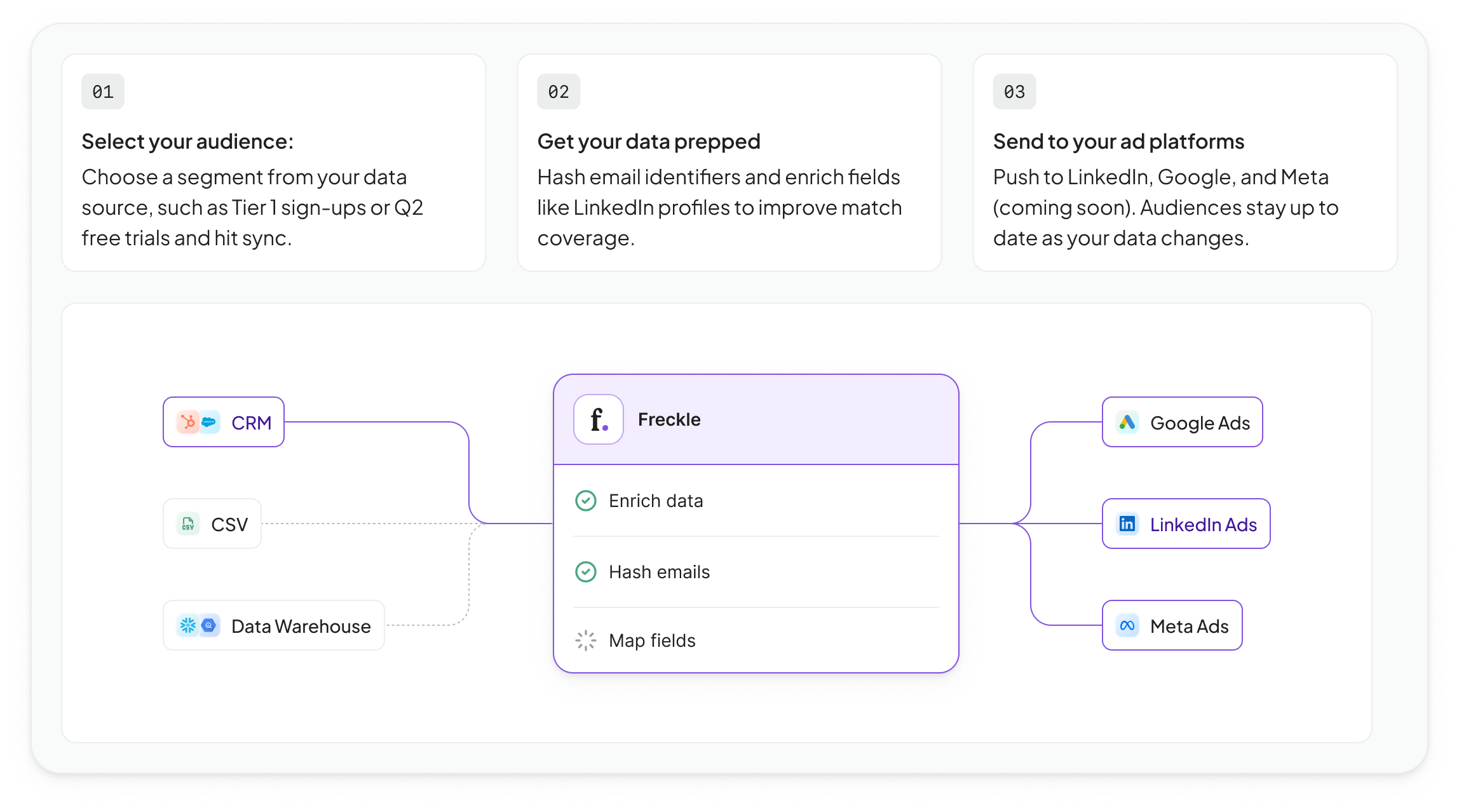
Setup requires admin-level access to your CRM and ad accounts. Most teams can go from initial connection to a live audience in under 15 minutes. Freckle manages the audience while campaigns, creative, and spend continue to run through your existing ad accounts.
Support for ad audiences is now available for LinkedIn and Google, with Meta coming soon.
Why we built it this way
Tools like Clay solve part of this problem, but still introduce constraints that show up once you try to scale campaigns. Namely, this can be seen in limits on how many audiences you can run, how much data can be synced, and how often those audiences update. In turn, we allow for:
- Unlimited audiences meaning you don’t have to decide which segments are worth syncing. If it exists in your CRM, it should be usable in your campaigns.
- No row limits meaning you are not trimming lists to fit a cap. The full audience makes it into your campaigns, which is what actually improves coverage.
- Flexible sync timing meaning audiences update on your schedule, from minutes to months. Campaigns move at different speeds, and the system should adapt to that.
These constraints can be manageable early on, but they compound quickly as teams add more segments and more platforms. Our feature removes that overhead so teams can keep running campaigns the way they already operate and get more out of the budgets they already have.
We built this alongside a cohort of agencies and in-house operators to ensure the functionality reflects how the best teams actually build audiences.
How teams are using it
Teams typically start with segments where both coverage and timing matter. High-intent cohorts such as product-qualified leads or contacts tied to active pipeline are common entry points because gaps in match rates or outdated lists have a direct impact on performance.
From there, usage expands into lifecycle targeting and exclusion management. Once audiences stay updated automatically, it becomes practical to rely on them across campaigns without maintaining separate lists for each platform.
For teams operating across multiple channels, defining an audience once and using it across Meta, LinkedIn, and Google removes a layer of coordination that is otherwise unwieldy.
What’s next
Ads Audiences addresses a specific gap between CRM data and paid execution, but it reflects a broader direction in how we think about building at Freckle.
Most GTM systems still require data to be exported and reshaped every time it needs to be used somewhere new. That creates friction and, over time, inconsistency between systems that should be aligned.
Our focus is on reducing that gap, making CRM data directly usable across systems without manual translation, so the same source of truth can carry through without ongoing maintenance.