" height="5.158250000000001px" id="f7Mf2yXru" transform="translate(8.704 2.519)" width="5.105983254629002px"/><path d="M 2.793 0 C 4.099 0 4.963 0.805 4.963 1.723 C 4.963 2.269 4.584 2.517 4.194 2.517 C 3.699 2.517 3.509 2.208 3.403 1.805 C 3.224 1.176 2.908 0.753 2.445 0.753 C 1.907 0.753 1.591 1.217 1.591 1.939 C 1.591 3.157 2.266 4.003 3.319 4.003 C 3.941 4.003 4.289 3.734 4.647 3.446 C 4.889 3.239 5.1 3.415 4.994 3.745 C 4.794 4.343 4.014 5.158 2.582 5.158 C 0.906 5.158 0 3.993 0 2.734 C 0 1.145 1.275 0 2.793 0 Z" fill="rgb(12, 10, 9)" height="5.158250000000001px" id="lH_H0CNPz" transform="translate(14.394 2.519)" width="5.022336111996651px"/><path d="M 2.75 0 C 4.078 0 4.784 0.794 4.911 1.671 C 4.932 1.826 4.847 1.981 4.668 2.063 C 3.625 2.558 2.898 2.857 1.865 3.25 C 2.086 3.652 2.519 4.013 3.256 4.013 C 3.867 4.013 4.352 3.704 4.731 3.353 C 4.963 3.136 5.184 3.332 5.079 3.652 C 4.879 4.261 3.973 5.158 2.529 5.158 C 1.022 5.158 0 4.158 0 2.724 C 0 1.124 1.328 0 2.75 0 Z M 3.33 1.568 C 3.161 0.991 2.698 0.65 2.224 0.774 C 1.781 0.877 1.528 1.31 1.528 1.919 C 1.528 2.135 1.57 2.414 1.623 2.579 C 2.108 2.414 2.603 2.239 3.067 2.022 C 3.246 1.94 3.425 1.878 3.33 1.568 Z" fill="rgb(12, 10, 9)" height="5.158250000000001px" id="FpPPCGWqn" transform="translate(29.746 2.519)" width="5.106008254629003px"/><path d="M 2.643 0 C 3.412 0 3.96 0.485 3.96 1.166 C 3.96 1.63 3.612 1.795 3.37 1.795 C 3.033 1.795 2.896 1.568 2.811 1.331 C 2.716 1.042 2.569 0.753 2.295 0.753 C 2.042 0.753 1.832 0.97 1.832 1.455 C 1.832 1.867 1.99 2.373 2.327 2.373 L 3.222 2.373 C 3.423 2.373 3.612 2.445 3.549 2.786 C 3.486 3.126 3.285 3.188 3.064 3.177 L 2.327 3.147 L 2.327 5.86 C 2.327 6.922 3.054 6.541 3.054 7.036 C 3.054 7.273 2.875 7.325 2.569 7.325 L 0.662 7.325 C 0.335 7.325 0.146 7.252 0.146 7.025 C 0.146 6.592 0.672 6.788 0.672 5.86 L 0.672 3.074 L 0.388 3.064 C 0.156 3.054 -0.044 3.002 0.008 2.724 C 0.051 2.424 0.262 2.373 0.514 2.373 L 0.672 2.373 C 0.672 0.836 1.558 0 2.643 0 Z" fill="rgb(12, 10, 9)" height="7.3247375px" id="EhG2za338" transform="translate(0 0.25)" width="3.959850000000003px"/><path d="M 1.917 0 C 2.118 0 2.191 0.124 2.191 0.351 L 2.181 1.764 L 2.181 4.849 L 3.551 3.425 C 4.014 2.94 3.33 2.981 3.33 2.62 C 3.33 2.424 3.498 2.373 3.804 2.373 L 5.195 2.373 C 5.447 2.373 5.616 2.445 5.616 2.631 C 5.616 2.961 5.015 2.878 4.488 3.435 L 4.267 3.662 L 5.447 6.241 C 5.647 6.685 6.174 6.706 6.174 7.077 C 6.174 7.273 5.995 7.325 5.679 7.325 L 4.025 7.325 C 3.698 7.325 3.519 7.253 3.519 7.067 C 3.519 6.727 4.035 6.788 3.814 6.314 L 3.129 4.859 L 2.181 5.86 C 2.181 6.798 2.697 6.541 2.697 7.036 C 2.697 7.273 2.518 7.325 2.213 7.325 L 0.505 7.325 C 0.189 7.325 0 7.252 0 7.025 C 0 6.541 0.526 6.798 0.526 5.86 L 0.516 1.764 C 0.516 1.145 0.021 1.166 0.021 0.856 C 0.021 0.702 0.116 0.619 0.369 0.505 C 0.79 0.309 1.748 0 1.917 0 Z" fill="rgb(12, 10, 9)" height="7.3247375px" id="nvzlq9ENi" transform="translate(19.848 0.25)" width="6.174374999999998px"/><path d="M 1.917 0 C 2.118 0 2.191 0.124 2.191 0.351 L 2.181 1.764 L 2.181 5.86 C 2.181 6.798 2.697 6.541 2.697 7.036 C 2.697 7.273 2.518 7.325 2.213 7.325 L 0.505 7.325 C 0.19 7.325 0 7.252 0 7.025 C 0 6.541 0.526 6.798 0.526 5.86 L 0.516 1.764 C 0.516 1.145 0.021 1.166 0.021 0.856 C 0.021 0.702 0.116 0.619 0.369 0.505 C 0.79 0.309 1.748 0 1.917 0 Z" fill="rgb(12, 10, 9)" height="7.3247375px" id="PY3lqacvC" transform="translate(26.526 0.25)" width="2.697249999999997px"/><path d="M 3.435 0 C 4.057 0 4.426 0.403 4.426 0.98 C 4.426 1.455 4.183 1.743 3.867 1.743 C 3.309 1.743 3.34 1.166 2.813 1.166 C 2.476 1.166 2.181 1.496 2.181 2.166 L 2.181 3.59 C 2.181 4.529 2.697 4.271 2.697 4.766 C 2.697 5.003 2.518 5.055 2.213 5.055 L 0.505 5.055 C 0.19 5.055 0 4.983 0 4.756 C 0 4.271 0.527 4.529 0.527 3.59 L 0.527 1.682 C 0.527 1.424 0.369 1.269 0.2 1.125 C 0.105 1.052 0 0.97 0 0.805 C 0 0.619 0.095 0.537 0.348 0.423 C 0.759 0.237 1.559 0.01 1.739 0 C 1.928 0 2.002 0.124 2.002 0.351 L 2.002 0.856 C 2.423 0.237 2.972 0 3.435 0 Z" fill="rgb(12, 10, 9)" height="5.054987499999999px" id="HaEl9TzlA" transform="translate(4.103 2.519)" width="4.425550000000001px"/><path d="M 4.309 0.092 C 4.228 0.013 4.109 0 3.987 0 L 0.416 0 C 0.294 0 0.174 0.013 0.093 0.094 C 0.013 0.175 0 0.294 0 0.417 C 0 0.532 0.014 0.647 0.093 0.727 C 0.173 0.807 0.291 0.824 0.416 0.824 L 3.987 0.824 C 4.112 0.824 4.231 0.807 4.311 0.724 C 4.369 0.663 4.392 0.582 4.399 0.495 L 4.403 0.406 C 4.403 0.288 4.389 0.171 4.309 0.092 Z" fill="rgb(99, 102, 241)" height="1px" id="Sk0He5HgV" transform="translate(35.597 6.906)" width="4.4028749999999945px"/></svg>)


Earlier this year, I wrote about why we were rebuilding Freckle around a CLI.
We had spent the previous two years growing Freckle to more than 7,000 users and hundreds of paying customers. Then, we noticed that some of our best customers were changing how they wanted to work.
They were increasingly using coding agents like Claude Code and Codex to take on work they would previously have done themselves, manually. The 10X AI lift that started with engineering teams was making its way to go-to-market teams, particularly among the technical operators and GTM engineers we worked with every day.
That raised a pretty fundamental question for us. If agents were going to become a primary way our customers worked, what did Freckle need to become to support them?
The decision to rebuild
When we first started exploring this product direction, the obvious path was to add a terminal interface to the existing Freckle product. However, the more we worked on it, the more convinced we became that this would miss the bigger opportunity.
Agents do not interact with software the same way people do. They need the product to expose the context, tools, data, and logic required to build and run a workflow without a human clicking through every step.
That meant the work went much deeper than building a new interface. We needed to fundamentally rethink the infrastructure underneath Freckle, how workflows were represented, how providers and integrations were exposed, and what role the UI should play when most of the building was happening somewhere else.
At that point, we had a stark choice. We could keep investing in the 1.0 product while experimenting around the edges, or we could redirect the company toward the product we believed our customers would want next.
We chose the latter.
I won't pretend that was an easy decision. We had thousands of users and a product customers relied on, and we were putting a large portion of the company's focus behind a product direction that was still new. But not acting felt like a bigger risk. If coding agents were going to change how GTM teams worked, continuing to optimize entirely for the old model would eventually leave us behind.
So we went all in.
What Freckle 2.0 unlocked
The goal for Freckle 2.0 was not just to make GTM workflows easier to build. We wanted the operator to move from manually constructing every workflow to orchestrating agents that could take on much more of that work for them.
You can now tell your preferred coding interface what you are trying to accomplish in natural language, whether that is enriching your CRM, building a target account list, tracking job changes, researching companies, or routing inbound leads, and let it handle the grunt work. Freckle gives the agent access to the data, tools, and workflow infrastructure it needs to figure out how to get there.
Most of that work happens in the terminal. The Freckle UI gives you a place to visualize what has been built, review the underlying data, and return to saved workflows.
The important part is that those workflows have outsized value. They can be saved, reused, and composed into larger systems, so something that starts as a single prompt can become repeatable infrastructure for your team. Instead of rebuilding the same logic over and over, operators can direct agents across a growing library of workflows and build on what they’ve already created.
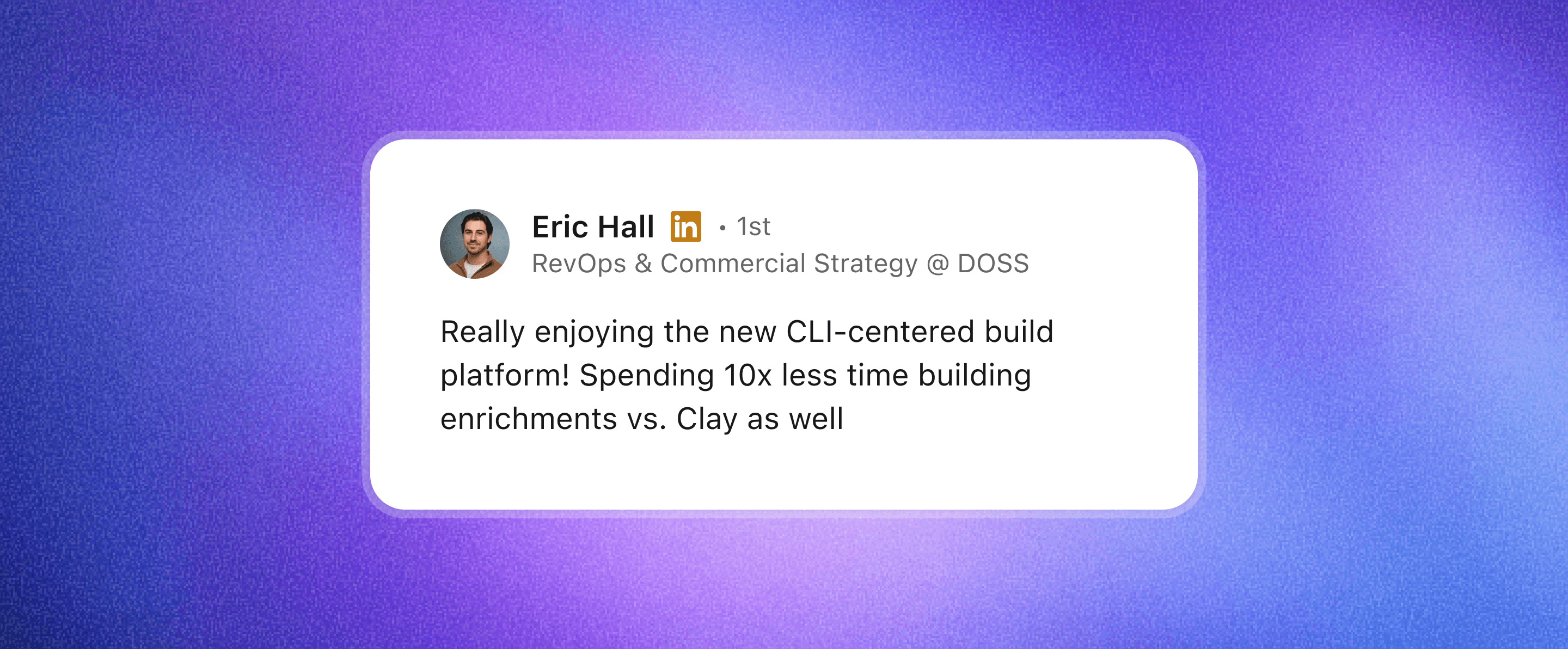
We had just started using the CLI for 100% of our own GTM workflows when I wrote the first post this spring. Since then, Freckle 2.0 has moved into the hands of hundreds of users, including customers who have transitioned from 1.0 and net-new users starting with Freckle for the first time. They’re building workflows across research, signal tracking, list building, CRM operations, inbound routing, and other recurring GTM work in a fraction of the time. It’s honestly magical to watch.
What comes next
We started Freckle to make it easier for GTM teams to work with better data without introducing more complexity. That has not changed. What has changed is how much of the work can now be handed off to agents, and what becomes possible when the operator is no longer responsible for manually building every step.
The best operators should be spending their time deciding what needs to happen, then directing agents and reusable workflows to make it happen. With Freckle powering those workflows, GTM engineers can now leverage coding agents to their full capacity. We’re incredibly excited to keep building alongside the operators pushing this way of working forward, and we’re just getting started.
If you want to experience Freckle 2.0 for yourself, you can start using the CLI today and get 1,000 credits on us.
Nathan Merzvinskis
Founder & CEO, Freckle